 info@masontec.ie

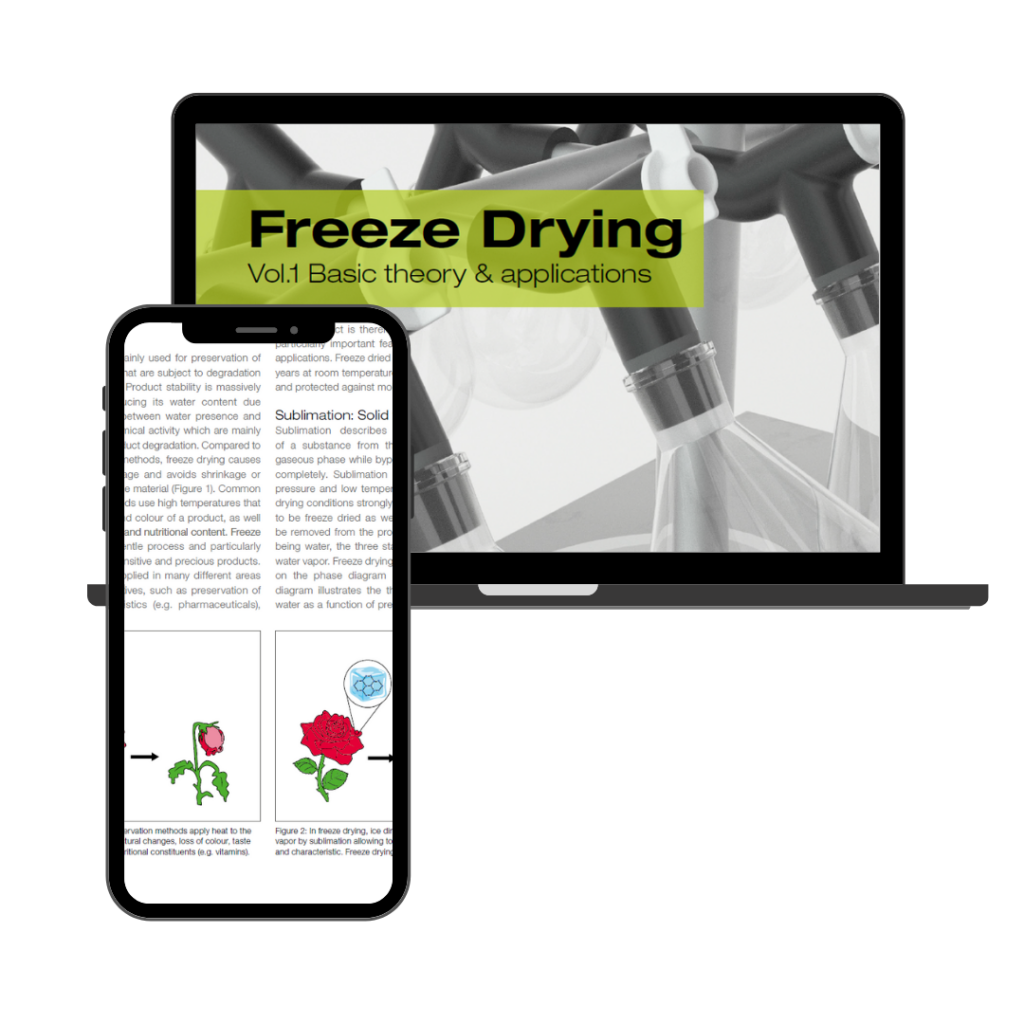
Freeze Drying: Basic Theory & Applications
Freeze Drying Volume 1: Basic Theory & Applications provides you with basic knowledge and applications for Freeze Drying
Freeze drying (lyophilisation) is used with many substances and materials to preserve, study, and prepare the materials in a dry state, while minimising the risk of degradation or alteration of their properties. It is a gentle process that protects the biological and chemical structure of a sample. Initially, the product is frozen and then dried by sublimation in an environment of reduced pressure. The low pressure enables direct changeover of the frozen solvent into vapor.
In most freeze drying applications, the solvent to be removed from the product is water. However, other solvents can be used to a certain extent, such as ethanol.
This ‘Freeze Drying Adviser: Basics and Applications’ from BUCHI examines the theory behind freeze drying and looks at a number of freeze drying applications.
- Freeze Drying
- Sublimation: Solid to gaseous
- Pressure and Temperature
- Driving Force Heat
- Freeze Dryer Components
- Freeze Drying Process
- Primary and Secondary Drying
- End Point Detection
- Drying Efficiency
- Drying Chamber Configurations
- Convenient Stoppering.
- Summary of Freeze-Drying Applications using the Lyovapor™ L-200:
- Lyophilisation of fresh banana slices
- Lyophilisation of fresh truffle slices
- Lyophilisation of mannitol and NaCl solutions in serum vials
- Lyophilisation of Traditional Chinese Medicine decoctions
RECENT POST
-
Vacuum Pump Specifications Explained: What Do the Key T...
Oct 01, 2026
Blog -
Mason Technology Appointed to Multiple Lots on NI Water...
Sep 21, 2026
News -
Oil-Sealed vs Dry Vacuum Pumps: Which Is Right for Your...
Sep 03, 2026
Blog -
Fast, Reliable Water Content Determination with EVA Kar...
Aug 31, 2026
Blog -
How to Choose the Right Vacuum Pump for Your Laboratory...
Aug 06, 2026
Blog -
Mason Technology Appointed Official Proteintech Distrib...
Aug 06, 2026
News -
Replacing Tap Water Cooling with Recirculating Chillers
Aug 05, 2026
Blog -
Mason Technology Appointed Irish Partner for Analytik J...
Jun 24, 2026
News