 info@masontec.ie

Net Content Compliance and Overfill Control in Manufacturing
This article forms part of the Mason Technology Manufacturing Quality Monitoring Series. The series explores the measurement technologies and production monitoring systems that help manufacturers maintain compliance, control process variation and improve production efficiency.
Manufacturers that sell packaged goods by weight or volume must ensure that the declared quantity on the label matches the product inside the package. In Ireland and across the European Union, these requirements are governed by regulations that define how manufacturers manage net content compliance.
However, maintaining compliance is not simply a regulatory exercise. Manufacturers must also control process variation, reduce product giveaway and monitor production performance continuously.
This article explores how manufacturers manage net content compliance, reduce overfill and use production monitoring techniques to maintain stable filling processes.
Net Content Compliance – An Introduction
Manufacturers that sell packaged goods by weight or volume must ensure that the declared quantity on the label matches the product inside the package. In Ireland and across the European Union, regulations define how manufacturers must manage net content compliance.
However, meeting these requirements can be challenging in practice. Filling processes naturally produce small variations in product weight. If these variations are not controlled, manufacturers risk underfilled packages or excessive overfill. Underfilling creates compliance risks, while overfilling increases product giveaway and production costs.
For this reason, manufacturers rely on statistical monitoring and production data to control filling processes. In this article, we explain how manufacturers manage net content compliance, reduce overfill and monitor filling processes using statistical methods.
What is Net Content Compliance?
Net content compliance refers to the requirement that packaged goods contain the quantity declared on the product label.
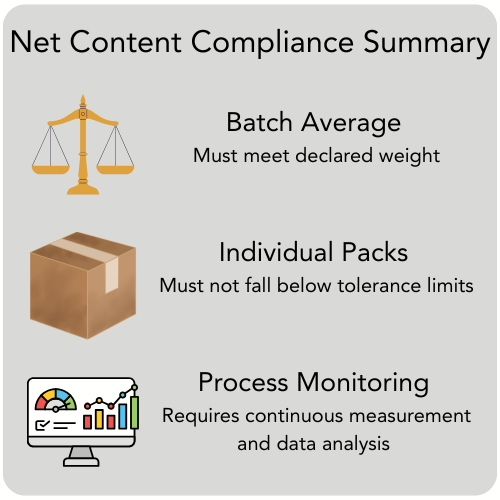
Under EU regulations, manufacturers must demonstrate that production processes meet several conditions:
- The average quantity in a batch must meet the declared value
- Individual packages must not fall below defined tolerance limits
- Production processes must be monitored and documented
To meet these requirements, manufacturers perform routine weight checks during production. In addition, they analyse production data to ensure that filling processes remain stable over time.
The Challenge of Overfill
While underfilling products creates compliance risks, excessive overfilling also presents a problem.
Many manufacturers set filling targets slightly above the declared quantity to reduce the risk of underfilled packages. However, this approach can lead to significant product giveaway if processes are not controlled carefully.
Even small overfill amounts can have a large financial impact when multiplied across high production volumes.
For example, a production line filling thousands of packages per hour may lose substantial quantities of product each day if the process is not monitored effectively.
As a result, manufacturers increasingly use statistical monitoring methods to understand process variation and optimise filling accuracy.
Monitoring Filling Processes
To maintain compliance and control product giveaway, manufacturers must monitor filling processes continuously.
Production lines generate measurement data from checkweighers, scales and other inspection equipment. However, collecting measurements alone does not provide insight into process performance.
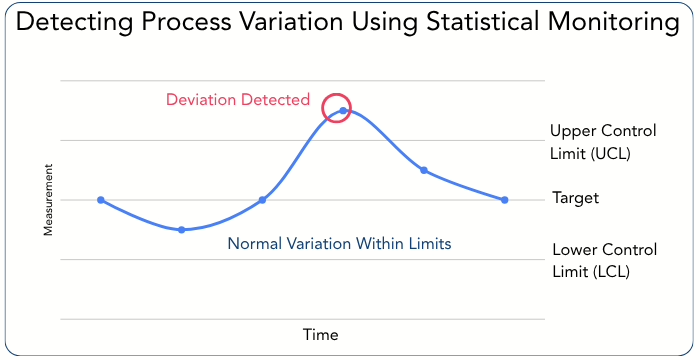
Instead, manufacturers analyse production data using statistical methods that reveal trends, variation and deviations from expected behaviour. This approach allows production teams to detect issues early and take corrective action before they affect product quality or compliance.
Expert Insight From Our Sales Team
“In many production environments, companies understand the regulatory requirements around net content. However, the real challenge is managing process variation on high-speed filling lines. Even small shifts in equipment performance can lead to product giveaway or compliance risks. Our role is to help customers understand how measurement and process monitoring reduce that uncertainty.”
The Role of Statistical Process Control
Statistical Process Control (SPC) is widely used to monitor production processes.
SPC uses statistical analysis to evaluate production measurements and identify variation within a process. By applying statistical rules, manufacturers can determine whether a process remains stable or whether adjustments are required.
For filling operations, SPC helps manufacturers:
- Detect shifts in fill weight trends
- Identify equipment drift or process variation
- Maintain compliance with declared quantities
- Reduce unnecessary product giveaway
As a result, SPC forms the foundation of modern production quality monitoring systems.
Why Manufacturers Partner with Mason Technology
Mason Technology supports manufacturers across Ireland with measurement and production monitoring technologies.
Our teams help customers implement solutions for:
- Industrial weighing and checkweighing
- Formulation and ingredient measurement
- Digital production quality monitoring
In addition, we provide installation, integration and ongoing technical support to ensure reliable operation in both laboratory and production environments.
Continue the Manufacturing Quality Monitoring Series

Statistical Process Control for Filling and Packaging Processes
Learn how to use statistical methods to detect equipment drift and manage process variation on high-speed lines.
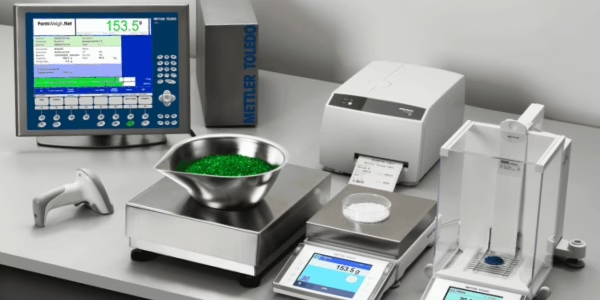
Digital Production Quality Monitoring with FreeWeigh.Net
Discover how to centralise your production data and gain real-time visibility into your manufacturing operations.

RECENT POST
-
Vacuum Pump Specifications Explained: What Do the Key T...
Oct 01, 2026
Blog -
Mason Technology Appointed to Multiple Lots on NI Water...
Sep 21, 2026
News -
Oil-Sealed vs Dry Vacuum Pumps: Which Is Right for Your...
Sep 03, 2026
Blog -
Fast, Reliable Water Content Determination with EVA Kar...
Aug 31, 2026
Blog -
How to Choose the Right Vacuum Pump for Your Laboratory...
Aug 06, 2026
Blog -
Mason Technology Appointed Official Proteintech Distrib...
Aug 06, 2026
News -
Replacing Tap Water Cooling with Recirculating Chillers
Aug 05, 2026
Blog -
Mason Technology Appointed Irish Partner for Analytik J...
Jun 24, 2026
News