 info@masontec.ie

Choosing the Right Light Microscope: A Practical Guide for Labs, Research Institutes, and Industry
Selecting the right microscope can be challenging, especially with so many different types, techniques, and specifications available. Whether you are working in a research lab, quality control environment, or educational setting, the right choice can significantly impact your results.
At Mason Technology, we have helped countless labs, universities, and manufacturing teams specify the ideal microscope for their needs. In this guide, we walk through the most common types of light microscopes and contrast methods, explaining where each works best and how they are used in real-world applications.
What Is a Light Microscope?
A light microscope, sometimes called an optical microscope, is an instrument that uses visible light and optical lenses to magnify small specimens. It is widely used across biology, medicine, materials science, and education to study cells, surfaces, and microstructures in detail.
Common Types of Light Microscopes and Use Cases
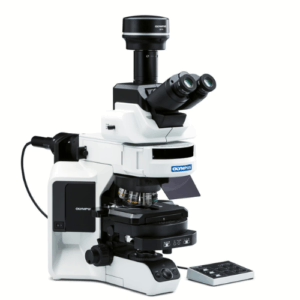
Compound Microscopes
- Best for: Examining thin, transparent specimens such as cells, bacteria, and tissues.
- Compound microscopes use multiple lenses (objective and eyepiece) to achieve high magnification and are the most common type found in labs and schools. They are ideal for stained specimens and offer sharp detail of internal structures.
- Used extensively in teaching, pathology, and basic research.
Stereo Microscopes (Dissecting Microscopes)
- Best for: Inspecting surfaces, small components, and 3D structures.
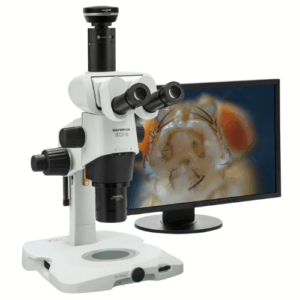
- Stereo microscopes provide lower magnification but offer a three-dimensional view of the sample. They are essential for analysing surface defects, examining insects and plants, or performing tasks that require depth perception such as dissecting or microsurgery.
Expert insight:
“In medical diagnostics and materials science, stereo microscopes are often preferred for their ability to reveal fine surface features, especially when examining medical device components for manufacturing defects.”
Fluorescence Microscopes
- Best for: Highlighting specific cell structures, tracking live-cell activity, and studying proteins or pathogens.
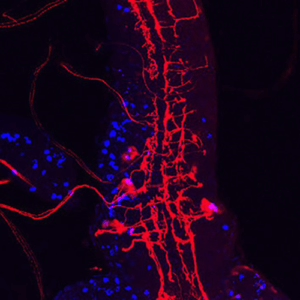
- Fluorescence microscopy uses high-intensity light and fluorescent dyes or proteins to visualise specific structures within a sample with vivid contrast. It is a powerful tool in medical diagnostics, microbiology, material science, and genetic research.
Expert insight:
“In collaboration with educational institutions and specialist labs, we have seen how fluorescence microscopes transform how students and researchers observe biological processes, offering unmatched insight into cellular dynamics.”
Confocal Microscopes
- Best for: High-resolution 3D imaging of thick or complex samples.
- Confocal microscopes use laser scanning and a pinhole aperture to produce sharp optical sections of a specimen. This technique allows detailed imaging at various depths, making it ideal for thick tissue samples or materials.
- Commonly used in advanced research in cell biology, neuroscience, and nanotechnology.
Inverted Microscopes
- Best for: Live-cell imaging, cell culture work, multi-well plates, and long-term time-lapse experiments.
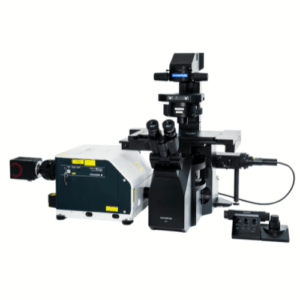
- Inverted microscopes position the objectives below the stage and the light source above the sample. This design is ideal for imaging cells that grow on the bottom of culture dishes or well plates.
- Commonly used in fluorescence and confocal imaging workflows and for automated high-content screening.
Choosing the Right Contrast Technique
Contrast techniques improve the visibility of structures that may otherwise be difficult to detect. Below are the most common types used in light microscopy.
Brightfield Microscopy
-
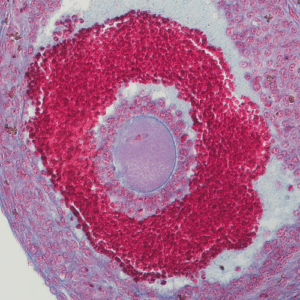
Method: Uses direct white light to illuminate the specimen, with contrast created through natural pigmentation or staining.
-
Best for: Stained or naturally coloured samples such as histology slides or bacteria.
-
Limitations: Reduced visibility for unstained, transparent specimens.
Darkfield Microscopy
-
Method: A special condenser blocks direct light and illuminates the sample with scattered light, causing the specimen to appear bright against a dark background.
-
Best for: Live, unstained, highly transparent samples such as bacteria or aquatic microorganisms.
-
Limitations: Less detail in thick samples and requires high-intensity lighting.
Phase-Contrast Microscopy
-
Method: Enhances image contrast by converting phase shifts in light waves into differences in brightness. No staining is required.
-
Best for: Live, transparent specimens such as mammalian cells or protozoa.
-
Limitations: Not suitable for thick samples and may produce halo artefacts.
Differential Interference Contrast (DIC) Microscopy (Nomarski Microscopy)
-
Method: Uses polarised light and specialised optical components to produce high-contrast, pseudo-3D images of transparent specimens.
-
Best for: Detailed imaging of live, unstained cells, including intracellular structures and organelles.
-
Limitations: More complex and more expensive than phase-contrast systems.
Fluorescence Microscopy
-
Method: Uses fluorescent dyes or proteins that emit light when excited by specific wavelengths, enabling targeted visualisation of cellular components.
-
Best for: Cellular and molecular biology, immunofluorescence, and neuroscience.
-
Limitations: Requires fluorescent labelling and may be affected by photobleaching.
Confocal Microscopy
-
Method: A laser scans the sample point by point to capture high-resolution optical sections while reducing background interference.
-
Best for: 3D imaging of thick or layered specimens such as tissues or biofilms.
-
Limitations: High cost, slower imaging, and requires fluorescent labelling.
Polarised Light Microscopy
-
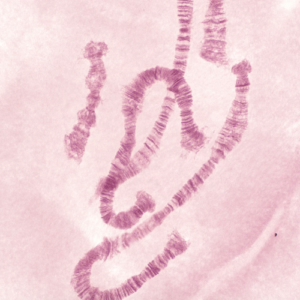
Method: Uses polarised light to enhance contrast in birefringent materials, which alter the polarisation of light.
-
Best for: Crystalline structures, minerals, muscle fibres, and polymers.
-
Limitations: Only effective with birefringent samples.
How We Can Help You Choose the Right Microscope
At Mason Technology, we go beyond simply supplying microscopes. We partner with our clients to deliver tailored, application-focused microscopy solutions backed by deep technical expertise.
Whether you work in medical diagnostics, advanced biological research, materials science, or education, our team has the knowledge and experience to guide you to the most suitable system. We supply and support a wide range of Evident microscopy products, from high-performance upright and inverted compound microscopes to stereo and digital systems ideal for 3D surface analysis.
We specialise in:
-
Core and advanced microscopy, including fluorescence, confocal, and live-cell imaging solutions.
-
Digital and automated microscopy for brightfield, fluorescence, and incubator-based imaging.
-
Imaging software, including the intuitive cellSens platform with advanced analysis, deconvolution, and AI integration.
Our clients span academic institutions, research labs, clinical settings, pharma, biopharma, and industry. We understand the specific challenges these environments face, whether imaging live cells over time, screening for material defects, or maintaining compliance in GMP environments.
Need Help Specifying a Microscope?
Choosing the right microscope depends on your samples, imaging goals, and workflow requirements. Our product specialists work closely with you to understand your needs and recommend the best-fit solution, from stereo microscopes for surface inspection to fully customisable research-grade systems such as the Evident BX3 and IX3 series.
Why Partner with Mason Technology?
- Decades of hands-on expertise across clinical, industrial, and research applications
- Full validation services, including IQ and OQ documentation
- Nationwide installation and support, with four regionally based, factory-trained engineers
- Compliance-ready software solutions, including 21 CFR Part 11 for regulated environmentsPartnership with Pax-IT to ensure our imaging systems meet FDA requirements for GMP settings

RECENT POST
-
Vacuum Pump Specifications Explained: What Do the Key T...
Oct 01, 2026
Blog -
Mason Technology Appointed to Multiple Lots on NI Water...
Sep 21, 2026
News -
Oil-Sealed vs Dry Vacuum Pumps: Which Is Right for Your...
Sep 03, 2026
Blog -
Fast, Reliable Water Content Determination with EVA Kar...
Aug 31, 2026
Blog -
How to Choose the Right Vacuum Pump for Your Laboratory...
Aug 06, 2026
Blog -
Mason Technology Appointed Official Proteintech Distrib...
Aug 06, 2026
News -
Replacing Tap Water Cooling with Recirculating Chillers
Aug 05, 2026
Blog -
Mason Technology Appointed Irish Partner for Analytik J...
Jun 24, 2026
News