 info@masontec.ie

Formulation Accuracy and Weighing Solutions for Consistent Baking Quality
Baking quality relies on a series of interconnected measurements. These measurements range from ingredient control and formulation accuracy through to finished product performance. At Mason Technology, we support baking and food producers with solutions that address each stage of this journey.
This article focuses on formulation accuracy and ingredient measurement. It builds on our earlier blog, which explored baking quality analysis for structure, colour, texture, volume and shape. Together, these articles form part of a wider series. The series shows how data-driven measurement supports consistent quality across baking, nutrition and food production workflows.
Formulation Accuracy and Weighing Solutions for Consistent Baking Quality
Baking quality begins long before dough enters the oven. For this reason, teams must control formulations and raw materials precisely. These controls support repeatable product performance across research, development and production environments.
In bakery research, flour milling, manufacturing and artisan settings, accurate weighing plays a central role. In practice, reliable ingredient measurement supports consistent dough characteristics, controlled fermentation and predictable final product quality.
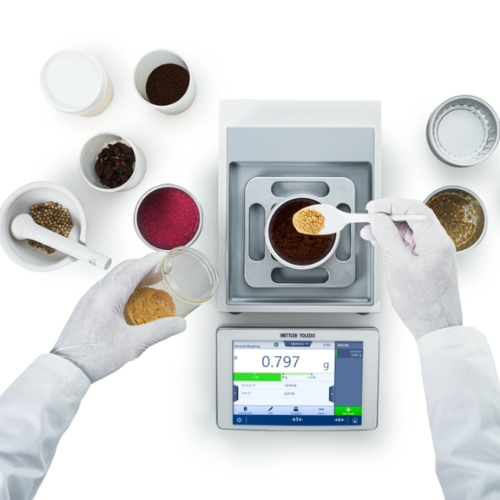
At Mason Technology, we support a wide range of formulation and weighing solutions. These include laboratory balances, moisture analysers, pH meters and industrial weighing systems. Together, these tools form the foundation for repeatable formulation, quality control and regulatory compliance.
Our sales teams work across laboratory, production and quality environments. As a result, their experience reflects real customer challenges when selecting weighing and measurement solutions for baking and food applications.
At a Glance
- What this covers: Formulation accuracy and ingredient measurement to support consistent baking quality
- Key technologies: Laboratory and industrial balances, moisture analysers, pH meters and titration solutions
- Main benefits: Improved formulation consistency, better control of raw material variability, more reliable quality data
- Typical users: Bakeries, flour millers, food R&D teams, nutrition and ingredient manufacturers
- Applications: Ingredient control, formulation development, moisture and fermentation monitoring, scale-up support
- Why Mason Technology: Cross-workflow expertise, application-led guidance and full lifecycle service support
Precision Weighing for Ingredient Control
Accurate weighing provides the first step toward consistent formulations. Even small deviations in ingredient weights can propagate through mixing, proofing and baking. As a result, variation can appear in texture, volume and appearance.
Mettler Toledo offers a broad portfolio of laboratory balances and industrial weighing solutions. These systems deliver reliable and repeatable performance in food environments. Analytical and precision balances support formulation work where ingredient ratios matter most. Meanwhile, bench scales and industrial systems handle batching, portioning and production control.
Expert insight from our sales team
“When we work with bakery R and D teams or flour millers, we first review how they weigh ingredients. Small inaccuracies at the formulation stage often explain inconsistencies later in the process. For this reason, we help customers choose balances and bench scales that suit their environment, whether that is a controlled lab or a busy production area.”
In some bakery and nutrition workflows, teams begin formulation control with incoming goods assessment. Alongside accurate weighing, organisations may apply complementary analytical techniques to check ingredient identity, authenticity and supplier consistency.
Depending on the application, teams may use chromatographic or profiling approaches, such as those supported by Shimadzu and CAMAG, to gain a clearer understanding of raw material performance.
Moisture Analysis for Ingredient and Dough Performance
Moisture content plays a critical role in baking. Variations in flour or ingredient moisture can influence hydration, dough handling and fermentation behaviour. Over time, these changes can also affect shelf life and product consistency.
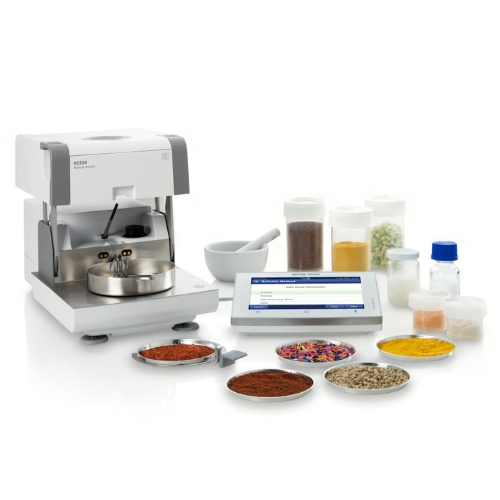
Mettler Toledo moisture analysers determine moisture content using loss-on-drying methods. These systems combine precise weighing with controlled heating. As a result, teams can use them for routine quality control, ingredient verification and in-process monitoring.
Expert insight from our sales team
“Moisture variability is a common issue we see, particularly with flour and blended ingredients. Often, customers notice changes in dough behaviour but struggle to identify the cause. When teams introduce routine moisture analysis, they gain visibility into raw material variability and can adjust formulations or processes before quality suffers.”
In bakery applications such as breadcrumbs and dried baked products, teams require moisture measurements that are both accurate and practical. Application studies show that halogen moisture analysers deliver results comparable to traditional oven drying methods. Importantly, they achieve this in a much shorter timeframe.
As a result, quality teams can make faster decisions, particularly when moisture variability affects texture, shelf life or downstream process performance.
While routine moisture analysis addresses a common source of variability, some organisations require deeper insight. In these cases, teams combine moisture data with broader ingredient characterisation techniques to understand compositional differences across batches or suppliers.
pH Measurement for Fermentation and Dough Chemistry
pH influences fermentation control, enzyme activity and gluten development. For this reason, teams monitor pH during ingredient preparation and dough development. This monitoring provides valuable insight into fermentation performance and dough chemistry.
Mettler Toledo pH meters provide accurate and stable measurements for laboratory and production use. Benchtop and portable options allow teams to monitor pH at different stages of the process, from raw materials through to dough systems.
Expert insight from our sales team
“pH measurement is sometimes overlooked in baking, especially outside research environments. However, once teams begin monitoring pH during fermentation or ingredient preparation, they often see clear links between acidity, fermentation control and final product characteristics. We help them choose systems that fit their workflow without adding unnecessary complexity.”
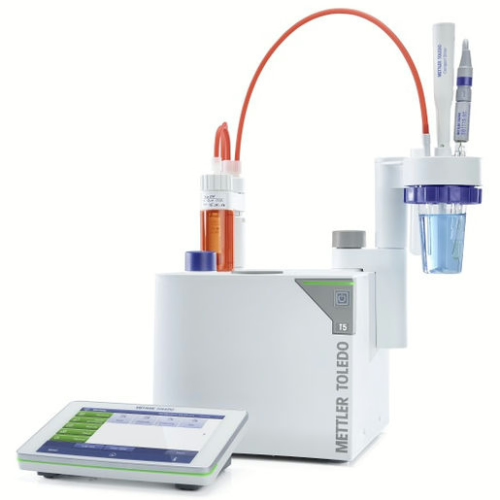
In addition to direct pH measurement, teams often assess overall acidity during fermentation. One common approach is the determination of total titratable acidity (TTA) using acid-base titration. This method provides a quantitative measure of the acids produced during fermentation and helps link fermentation behaviour to flavour development and finished bread quality.
The image below shows a typical titration system used to determine total titratable acidity in bread. Titration allows bakeries and food laboratories to measure acidity in a consistent and repeatable way, providing a useful indicator of fermentation performance and product taste.
A practical example of this method is described in the application note “Total Titratable Acidity (TTA) of Bread – Quality and Taste Indicator.”
By combining accurate weighing, calibrated pH measurement and automated titration, bakeries and research teams gain deeper insight into fermentation dynamics and formulation performance.
Formulation Control from Laboratory to Pilot Scale
As formulations move from laboratory research into pilot or scale-up environments, teams must maintain accurate weighing, moisture and pH measurement. At this stage, ingredient behaviour can change due to batch size, processing conditions or equipment differences.
Consistent formulation data helps teams interpret these changes correctly. In practice, it allows them to distinguish scale effects from raw material variability. As a result, teams can make more confident decisions before full production trials.
Bringing Formulation Control and Quality Analysis Together
Formulation accuracy underpins all downstream quality measurements. Without reliable control of ingredient weights, moisture and pH, teams struggle to interpret quality data. This includes data from crumb structure, texture, colour and volume analysis tools.
When teams control formulation variables effectively, they can link ingredient changes more confidently to final product performance. Therefore, this integrated approach supports:
- Repeatable batch formulation
- Consistent dough handling and fermentation
- Reliable texture, volume and sensory outcomes
- Reduced process variation and waste
Expert insight from our sales team
“We often work with customers who already use crumb structure or texture analysis. However, they sometimes struggle to interpret the results. In many cases, upstream measurement provides the missing context. When teams control formulation and weighing properly, quality data becomes much more meaningful and easier to act on.”
Why Partner with Mason Technology
Mason Technology supports customers across formulation, quality control and production workflows. Beyond supplying instrumentation, we provide application expertise and long-term technical support to help teams implement reliable measurement solutions.
Our specialists work with customers from initial specification through installation, calibration and ongoing service. This ensures systems remain accurate, compliant and fit for purpose.
If you would like to explore how formulation accuracy and weighing solutions can support your bakery, flour mill or food research operation, the Mason Technology team is ready to help.
We provide:
- Presales guidance to identify suitable balances, moisture analysers and pH meters
- Demonstrations of laboratory and production weighing solutions
- Installation, validation and calibration support
- Training and application assistance
Baking quality depends on accurate measurement across the entire workflow, from ingredient control through to finished product analysis. The Mason Technology Baking Quality Series explores the technologies and analytical approaches that support consistent, data-driven baking processes.
Together, these articles highlight how Mason Technology supports bakeries, flour producers and food research teams with connected solutions, expert guidance and long-term technical support.
Other Articles in this Series
Baking Quality Analysis Solutions for Structure, Colour and Texture

RECENT POST
-
Oil-Sealed vs Dry Vacuum Pumps: Which Is Right for Your...
Sep 03, 2026
Blog -
Fast, Reliable Water Content Determination with EVA Kar...
Aug 31, 2026
Blog -
How to Choose the Right Vacuum Pump for Your Laboratory...
Aug 06, 2026
Blog -
Mason Technology Appointed Official Proteintech Distrib...
Aug 06, 2026
News -
Replacing Tap Water Cooling with Recirculating Chillers
Aug 05, 2026
Blog -
Mason Technology Appointed Irish Partner for Analytik J...
Jun 24, 2026
News -
Jun 16, 2026
News -
PFAS Analysis Expert Panel Discussion: Your Questions A...
Jun 15, 2026
Blog