 info@masontec.ie

Replacing Tap Water Cooling with Recirculating Chillers
A Practical Step Towards More Sustainable Laboratories
Universities across Ireland are placing greater emphasis on laboratory sustainability. Faculty-wide initiatives and internationally recognised programmes such as My Green Lab Certification are encouraging research groups to examine everyday laboratory practices and identify practical ways to reduce resource consumption without compromising research quality.
Research laboratories are among the most resource-intensive spaces on university campuses. Continuous operation of laboratory equipment, together with strict environmental control requirements, means even small improvements can have a meaningful impact on water consumption, energy use and operating costs.
While behavioural changes are an important part of creating a sustainable laboratory culture, equipment selection also plays a significant role. One often overlooked opportunity is replacing once-through tap water cooling with a closed-loop recirculating chiller.
For laboratories using rotary evaporators, condensers, vacuum pumps or other water-cooled equipment, this relatively simple change can improve sustainability, reduce operating costs and deliver more consistent experimental performance.
Understanding why more universities are making this transition begins with examining how traditional tap water cooling works and where opportunities for improvement exist.
Why is Tap Water Cooling Still Used?
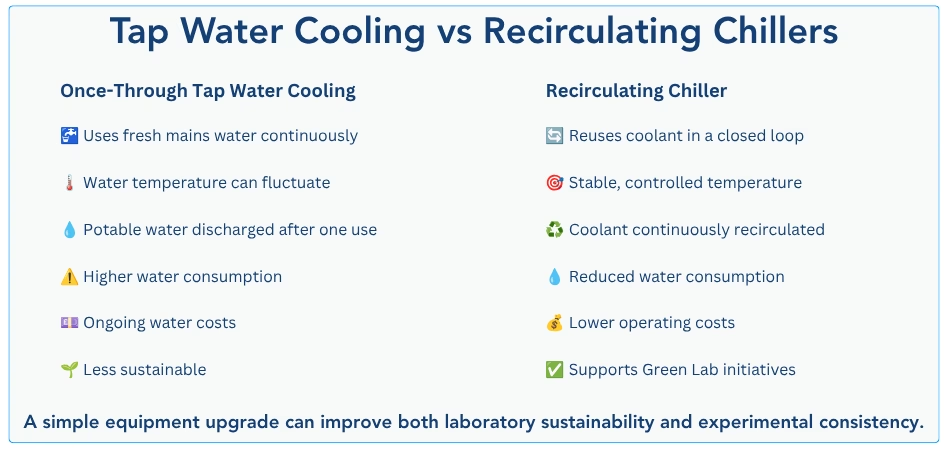
Many laboratory instruments require cooling to remove heat generated during operation. Traditionally, this has been achieved using a continuous supply of tap water.
Common Applications for Recirculating Chillers
- Rotary evaporators
- Condensers
- Vacuum pumps
- Small-scale reactors
- Analytical instruments
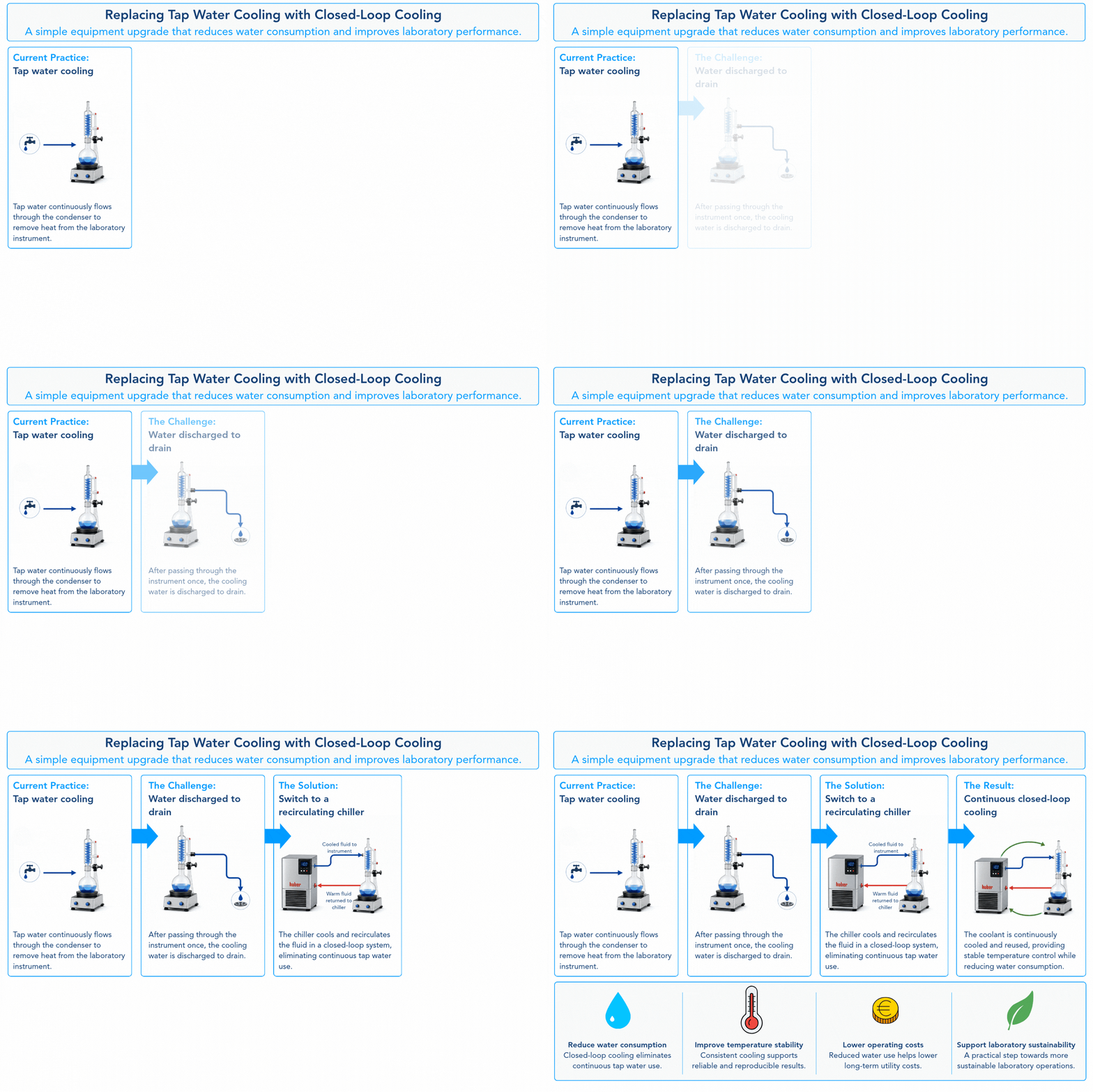
Although this approach is simple, it also means that potable water is used once before being discharged to waste.
For laboratories operating multiple water-cooled instruments every day, this can represent a surprisingly large and often hidden source of water consumption.
Why Universities Are Rethinking Laboratory Cooling
Universities are increasingly reviewing laboratory practices to support:




The Hidden Cost of Tap Water Cooling
The environmental impact of tap water cooling extends beyond water consumption.
Continuous water use increases operating costs while placing unnecessary demand on treated potable water. In addition, mains water temperature can fluctuate throughout the year and even during the day as building demand changes.
These fluctuations can affect cooling performance, particularly during long experiments or solvent evaporation processes where consistent temperatures are important.
There are also operational risks. Because once-through systems rely on a continuous mains water supply, a disconnected hose or fitting failure can result in significant water leakage, potentially damaging laboratory equipment and disrupting research activities.
As universities work towards more sustainable laboratories, these limitations are encouraging many research groups to adopt closed-loop cooling systems.
How Recirculating Chillers Work
Unlike once-through cooling, recirculating chillers operate as closed-loop systems.
Instead of allowing cooling water to flow directly to waste, the chiller continuously circulates coolant through the instrument before cooling and reusing it.
This approach offers several important advantages:
- Significantly reduces potable water consumption
- Provides stable and precise temperature control
- Delivers consistent cooling throughout the year
- Reduces dependence on mains water
- Supports more sustainable laboratory operation
For many laboratory applications, a recirculating chiller improves both process control and resource efficiency.
Sustainability Should Never Come at the Expense of Research Quality
Laboratory sustainability initiatives should support research rather than compromise it.
One of the major advantages of recirculating chillers is their ability to maintain a stable cooling temperature throughout an experiment. Unlike tap water, which varies with seasonal conditions and building demand, a recirculating chiller delivers a controlled and consistent cooling temperature.
This helps improve experimental reproducibility while providing more reliable operating conditions for temperature-sensitive applications.
Consistent condenser temperatures can also support more effective solvent condensation during evaporation processes, helping laboratories maximise solvent recovery while reducing solvent losses.
Supporting Sustainability Through Better Equipment Design
Modern recirculating chillers are designed to improve both environmental performance and operational efficiency.
Huber’s laboratory cooling units incorporate technologies that help laboratories reduce resource consumption while maintaining precise temperature control. Depending on the model, these include:
- Natural refrigerants with low global warming potential
- High-efficiency refrigeration systems
- Precise electronic temperature control
- Compact designs that optimise laboratory space
- Reliable continuous operation for demanding research environments
Huber has been developing laboratory temperature control systems using natural refrigerants for decades, and natural refrigerants are now standard across its laboratory cooling range.
Some Huber recirculating chillers can also be configured to support multiple laboratory applications from a single unit where cooling demand allows, helping laboratories further optimise equipment utilisation and reduce overall resource consumption.
Supporting Green Lab Initiatives
Green Lab programmes encourage laboratories to look beyond individual pieces of equipment and consider how everyday laboratory practices contribute to overall sustainability.
Replacing once-through cooling with a recirculating chiller aligns well with these objectives by helping laboratories:
- Reduce unnecessary potable water consumption
- Improve resource efficiency
- Support responsible equipment selection
- Maintain consistent experimental conditions
- Reduce operational costs over time
For universities working towards Green Lab Certification, equipment choices such as these can form part of a wider programme of continuous environmental improvement.
Supporting Sustainable Laboratories
Improving laboratory sustainability rarely depends on a single change.
Meaningful improvements are achieved by combining efficient equipment with effective monitoring, preventative maintenance and good laboratory practices.
At Mason Technology, we work with universities and research organisations across Ireland to help identify practical opportunities to improve laboratory efficiency. Alongside Huber’s range of recirculating chillers, we also support laboratories with environmental monitoring systems, accredited calibration services, temperature and humidity mapping, and preventative maintenance to help maintain reliable laboratory performance.
Replacing tap water cooling with a recirculating chiller is one practical example of how laboratories can reduce water consumption while supporting both research excellence and institutional sustainability goals.
Key Takeaways
- Once-through tap water cooling can consume significant volumes of potable water.
- Closed-loop recirculating chillers reuse coolant continuously, reducing unnecessary water consumption.
- Stable cooling temperatures support experimental consistency and reproducibility.
- Closed-loop systems reduce the risk of flooding associated with continuous mains water supplies.
- Modern recirculating chillers combine precise temperature control with improved resource efficiency.
- Replacing tap water cooling supports broader laboratory sustainability and Green Lab initiatives.

RECENT POST
-
Vacuum Pump Specifications Explained: What Do the Key T...
Oct 01, 2026
Blog -
Mason Technology Appointed to Multiple Lots on NI Water...
Sep 21, 2026
News -
Oil-Sealed vs Dry Vacuum Pumps: Which Is Right for Your...
Sep 03, 2026
Blog -
Fast, Reliable Water Content Determination with EVA Kar...
Aug 31, 2026
Blog -
How to Choose the Right Vacuum Pump for Your Laboratory...
Aug 06, 2026
Blog -
Mason Technology Appointed Official Proteintech Distrib...
Aug 06, 2026
News -
Replacing Tap Water Cooling with Recirculating Chillers
Aug 05, 2026
Blog -
Mason Technology Appointed Irish Partner for Analytik J...
Jun 24, 2026
News