 info@masontec.ie

Oil-Sealed vs Dry Vacuum Pumps: Which Is Right for Your Application?
One of the questions I am asked most often is whether a customer should choose an oil-sealed or dry vacuum pump.
There is no universally correct answer. Both technologies offer significant advantages, and the best choice depends on the application rather than the pump itself.
In the first article in this series, I looked at the key questions to consider when selecting a vacuum pump. Deciding between oil-sealed and dry technology is one of those decisions, and understanding the differences can help you achieve reliable performance while managing maintenance and operating costs over the life of the pump.
The choice between oil-sealed and dry technology should not be viewed as a progression from one technology to another. Both remain well-established vacuum solutions, and each offers advantages depending on the application.
The objective is to understand where each technology performs best and select accordingly.
Oil-Sealed
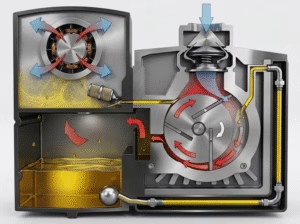
Oil-sealed rotary vane pumps have been used successfully in laboratories and industry for decades.
The oil performs several important functions within the pump, providing lubrication, sealing and cooling. This allows oil-sealed pumps to achieve excellent vacuum performance with proven reliability.
They are commonly used for applications including:
- Rotary evaporators
- Vacuum ovens
- Freeze dryers
- General laboratory vacuum
- Industrial processes
For many applications, an oil-sealed rotary vane pump remains a robust and cost-effective solution.
Oil-sealed rotary vane pumps remain a strong choice for many applications, particularly where:
- Low ultimate pressure is required
- Proven, robust vacuum technology is a priority
- Oil within the pumping mechanism does not present a process concern
- The process is compatible with the pump oil and appropriate protection measures
- Regular oil and filter maintenance can be incorporated into the maintenance programme
- Initial capital cost is an important consideration
For applications with these requirements, moving to dry technology does not necessarily provide a process or economic advantage.
The use of oil also introduces some factors that need to be considered when assessing whether this technology is right for your process.
Oil backstreaming: In some applications, oil vapour can migrate from the pump back towards the vacuum system. Where process cleanliness is critical, the potential for contamination needs to be considered and appropriately managed.
Process contamination of the oil: The reverse can also occur. Solvents, moisture and other process vapours entering the pump can contaminate the oil, affecting both oil condition and pump performance.
Oil changes and disposal: Oil must be monitored and replaced at appropriate intervals, creating an ongoing maintenance requirement as well as waste oil that needs to be managed and disposed of correctly.
Process chemistry: Oil-sealed pumps may require additional consideration when handling significant quantities of solvents, corrosive gases or other aggressive process vapours. The suitability of the pump, oil and any inlet or exhaust protection should be assessed against the specific process.
These considerations do not make oil-sealed technology unsuitable. They simply need to form part of the selection and maintenance strategy.
Dry Vacuum
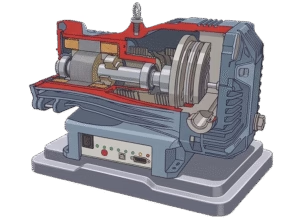
Dry vacuum pumps operate without oil or other lubricants in the pumping chamber.
There are several types of dry vacuum technology, including scroll, screw and diaphragm pumps. Although they operate differently, they share an important characteristic: the process gas does not come into contact with lubricating oil within the pumping mechanism.
This significantly reduces the potential for oil contamination and eliminates routine oil management within the pumping chamber.
Depending on the technology, dry pumps are commonly selected for:
- Pharmaceutical manufacturing
- Analytical laboratories and instrumentation
- Clean processes
- Semiconductor applications
- Chemical processing
- Research laboratories
It is important, however, not to treat “dry vacuum pump” as a single technology. A dry scroll pump, for example, has different operating characteristics from a dry screw or diaphragm pump. The application still needs to determine which dry technology is appropriate.
Depending on the technology, dry pumps can be particularly well suited to applications where:
- An oil-free pumping chamber is required
- Process cleanliness is particularly important
- Samples or processes are sensitive to potential oil contamination
- Routine oil management needs to be eliminated
- The specific dry technology is compatible with the gases or vapours being handled
These requirements can arise across pharmaceutical manufacturing, analytical laboratories, semiconductor applications, chemical processing, research and other laboratory and industrial environments.
Dry does not mean maintenance-free.
Different dry technologies contain components that wear over time and have their own servicing requirements. Their suitability for solvents, corrosive gases, particles and other process contaminants also varies considerably.
Dry pumps can also carry a higher initial purchase price than oil-sealed alternatives.
The correct question is therefore not simply whether a dry pump requires less maintenance. You need to consider what maintenance each technology requires, how it will perform with your process gases and what it will cost over its complete operating life.
Oil-Sealed vs Dry Vacuum Pumps: Comparison at a Glance
The exact performance of any vacuum pump depends on the specific technology and model, but the following provides a useful general comparison.
| Consideration | Oil-Sealed Vacuum Pump | Dry Vacuum Pump |
|---|---|---|
| Vacuum performance | Excellent performance across many laboratory and industrial applications | Performance depends on the specific dry technology |
| Oil in pumping chamber | Yes | No |
| Process cleanliness | Suitable where oil does not present a process concern; additional controls may be available where required | Strong option where an oil-free pumping chamber is important |
| Process vapours | Compatibility and appropriate protection measures should be assessed | Compatibility depends on the specific dry technology |
| Routine oil changes | Required | Not required in the pumping chamber |
| Maintenance | Established maintenance requirements including oil and filters | Technology-specific maintenance requirements |
| Initial investment | Often lower | Often higher |
| Operating costs | Application and duty dependent | Application and duty dependent |
| Best suited to | Applications where proven performance, low ultimate pressure and cost-effectiveness are priorities | Applications where oil-free operation and process cleanliness are priorities |
This comparison should be treated as a starting point rather than a specification guide. Individual pump technologies and models can differ significantly.
What About Solvents and Corrosive Vapours?
This deserves particular attention because it is easy to oversimplify the difference between oil-sealed and dry pumps.
If the pump will handle solvents, water vapour or corrosive gases, the process chemistry should be understood before a pump is selected.
With an oil-sealed pump, vapours can contaminate or degrade the oil. Depending on the process, measures such as gas ballast, inlet traps or condensers may help manage the vapour load.

Dry technology removes oil from the pumping chamber, but that does not automatically make every dry pump suitable for every solvent or corrosive process. Materials of construction, operating temperature and the specific pumping mechanism all need to be considered.
This is why vacuum level and pumping speed alone are not enough to select a pump.
Which Should You Choose?
Neither oil-sealed nor dry vacuum technology should be considered the default choice.
Oil-sealed rotary vane pumps remain a highly effective solution across many laboratory and industrial applications. Where they provide the required vacuum performance, the process is compatible with oil-sealed operation and routine maintenance can be appropriately managed, oil-sealed technology can continue to provide an effective and cost-efficient solution.
Dry vacuum technology becomes particularly attractive where an oil-free pumping chamber, process cleanliness or eliminating routine oil management provides a clear operational advantage.
There are also applications where other factors, including process gases, vapours, duty cycle and required operating pressure, will ultimately determine the most appropriate technology.
Rather than starting with a preference for oil-sealed or dry, I recommend starting with the process:
- What vacuum level is required?
- What pumping speed is needed?
- What gases and vapours will the pump handle?
- Is the process sensitive to oil contamination?
- How frequently and for how long will the pump operate?
- What maintenance regime is practical?
- What are the expected lifetime operating costs?
Once those requirements are understood, it becomes much easier to identify the vacuum technology that provides the best fit.
Final Thoughts
Vacuum pump selection is rarely a one-size-fits-all decision.
Oil-sealed and dry vacuum pumps both have an important place in laboratory and industrial vacuum systems. The objective is not to determine which technology is universally better, but which is better suited to your particular process.
Reviewing the application carefully helps ensure the selected technology delivers the required performance while managing contamination risk, maintenance and operating costs throughout its working life.
In the next article in this series, we’ll look at some of the key specifications used when comparing vacuum pumps, including vacuum level, pumping speed, pump-down time and ultimate vacuum.
Continue the Vacuum Pump Series
How to Choose the Right Vacuum Pump for Your Laboratory or Industrial Application
Learn how to choose the right vacuum pump for laboratory and industrial applications. Discover the key factors to consider before selecting a vacuum pump.
Vacuum Pump Specifications Explained: What Do the Key Terms Mean?
Understand the 4 critical vacuum pump specifications: vacuum level, pumping speed, pump-down time and ultimate vacuum and how to size for your entire system.

RECENT POST
-
Vacuum Pump Specifications Explained: What Do the Key T...
Oct 01, 2026
Blog -
Mason Technology Appointed to Multiple Lots on NI Water...
Sep 21, 2026
News -
Oil-Sealed vs Dry Vacuum Pumps: Which Is Right for Your...
Sep 03, 2026
Blog -
Fast, Reliable Water Content Determination with EVA Kar...
Aug 31, 2026
Blog -
How to Choose the Right Vacuum Pump for Your Laboratory...
Aug 06, 2026
Blog -
Mason Technology Appointed Official Proteintech Distrib...
Aug 06, 2026
News -
Replacing Tap Water Cooling with Recirculating Chillers
Aug 05, 2026
Blog -
Mason Technology Appointed Irish Partner for Analytik J...
Jun 24, 2026
News