 info@masontec.ie

Vacuum Pump Specifications Explained: What Do the Key Terms Mean?
When comparing vacuum pumps, you’ll encounter specifications such as vacuum level, pumping speed and ultimate vacuum. These figures are important, but looking at any one of them in isolation can lead to the wrong pump being selected.
In the first articles in this series, I looked at the questions to ask when choosing a vacuum pump and the differences between oil-sealed and dry vacuum technologies. The next step is understanding how pump performance is specified and, more importantly, what those specifications mean for your application.
Four terms are particularly useful to understand: vacuum level, pumping speed, pump-down time and ultimate vacuum.
The 4 Core Specifications at a Glance
| Specification | What It Answers | What It Really Measures |
|---|---|---|
| 1. Vacuum Level | What pressure does my process require? | Pressure level inside the vessel/system |
| 2. Pumping Speed | How fast can gas be evacuated? | Volume of gas displaced per unit time (m³/h or L/s) |
| 3. Pump-Down Time | How long will it take to reach target vacuum? | Duration to pull down from start to target pressure |
| 4. Ultimate Vacuum | How low can the pump theoretically go? | Lowest achievable pressure under test conditions |
1. Vacuum Level: What Pressure Does Your Process Require?
Vacuum level describes the pressure within the vacuum system.
As a vacuum pump removes gas molecules from a vessel or system, the pressure falls. The fewer gas molecules remaining, the lower the pressure and the greater the vacuum.
This is important because different processes operate at very different pressures. The objective is not necessarily to achieve the deepest possible vacuum. It is to achieve and maintain the pressure your process requires.
Selecting a pump capable of reaching a much lower pressure than your application needs may add unnecessary cost or complexity without improving process performance.
The first question should therefore be:
What operating pressure does my process actually require?
That becomes the starting point for assessing suitable vacuum technologies.
2. Pumping Speed: How Quickly Can the Pump Remove Gas?
Pumping speed describes the volume of gas a vacuum pump can remove at a given pressure and is commonly expressed in units such as cubic metres per hour (m³/h) or litres per second (L/s).
It is tempting to assume that a higher pumping speed is always better. It isn’t.
The appropriate pumping speed depends on factors including:
- The volume of the vessel or system
- The required operating pressure
- The amount of gas entering the system
- Process-generated gases or vapours
- Pipework and system design
- Required cycle time
This is where understanding the application becomes particularly important.
A pump may appear correctly sized based on chamber volume alone but struggle to maintain the required pressure if the process generates a significant continuous gas or vapour load.
Similarly, restrictions within pipework, valves or other components can reduce the effective pumping speed available at the process.
The number on the pump datasheet therefore doesn’t necessarily represent the pumping performance you’ll achieve at the point of use.
3. Pump-Down Time: How Long Will It Take to Reach the Required Vacuum?
Pump-down time is the time required to reduce the pressure within a system from its starting pressure to the target operating pressure.
For processes that repeatedly evacuate a chamber, pump-down time can have a direct impact on cycle time and productivity.
Several factors influence it, including:
- Chamber or vessel volume
- Starting pressure
- Target pressure
- Pumping speed
- Pipe diameter and length
- Valves and restrictions
- Leaks
- Process gas load
- Moisture and other vapours within the system
This is why simply installing a larger pump doesn’t always produce the expected reduction in pump-down time.
If pipework is restrictive, the system has leaks or significant quantities of gas are continuously being introduced, increasing nominal pump capacity may provide limited benefit.
The vacuum system needs to be considered as a whole.
4. Ultimate Vacuum: How Low Can the Pump Go?
Ultimate vacuum, sometimes referred to as ultimate pressure, is the lowest pressure a vacuum pump can achieve under specified conditions.
It is an important technical specification, but it is also one that can receive too much attention during pump selection.
A pump capable of achieving a very low ultimate pressure isn’t automatically better for your application.
If your process operates well above that pressure, the more relevant considerations may be whether the pump can:
- Reach the required operating pressure reliably
- Maintain that pressure under the actual gas load
- Deliver sufficient pumping speed at the operating pressure
- Handle the gases and vapours generated by the process
Think of ultimate vacuum as the lower limit of the pump’s capability rather than the pressure at which it will necessarily operate in your process.
Ultimate Vacuum and Operating Vacuum Are Not the Same Thing
This distinction is particularly important.
The ultimate vacuum quoted for a pump is typically determined under defined test conditions. Your actual operating pressure will be influenced by the complete system and process.
Factors such as air leaks in pipework, flanges, gaskets or valve seats can affect the vacuum achieved. So can process gases, solvent vapours, moisture, contamination and restrictions within the vacuum line.
If a vacuum system isn’t reaching the expected pressure, it doesn’t therefore follow that the pump itself is underperforming. The problem may be elsewhere in the system.
We’ll look at this in more detail in the next article in this series on common vacuum pump problems and how to prevent them.
How the Four Specifications Work Together
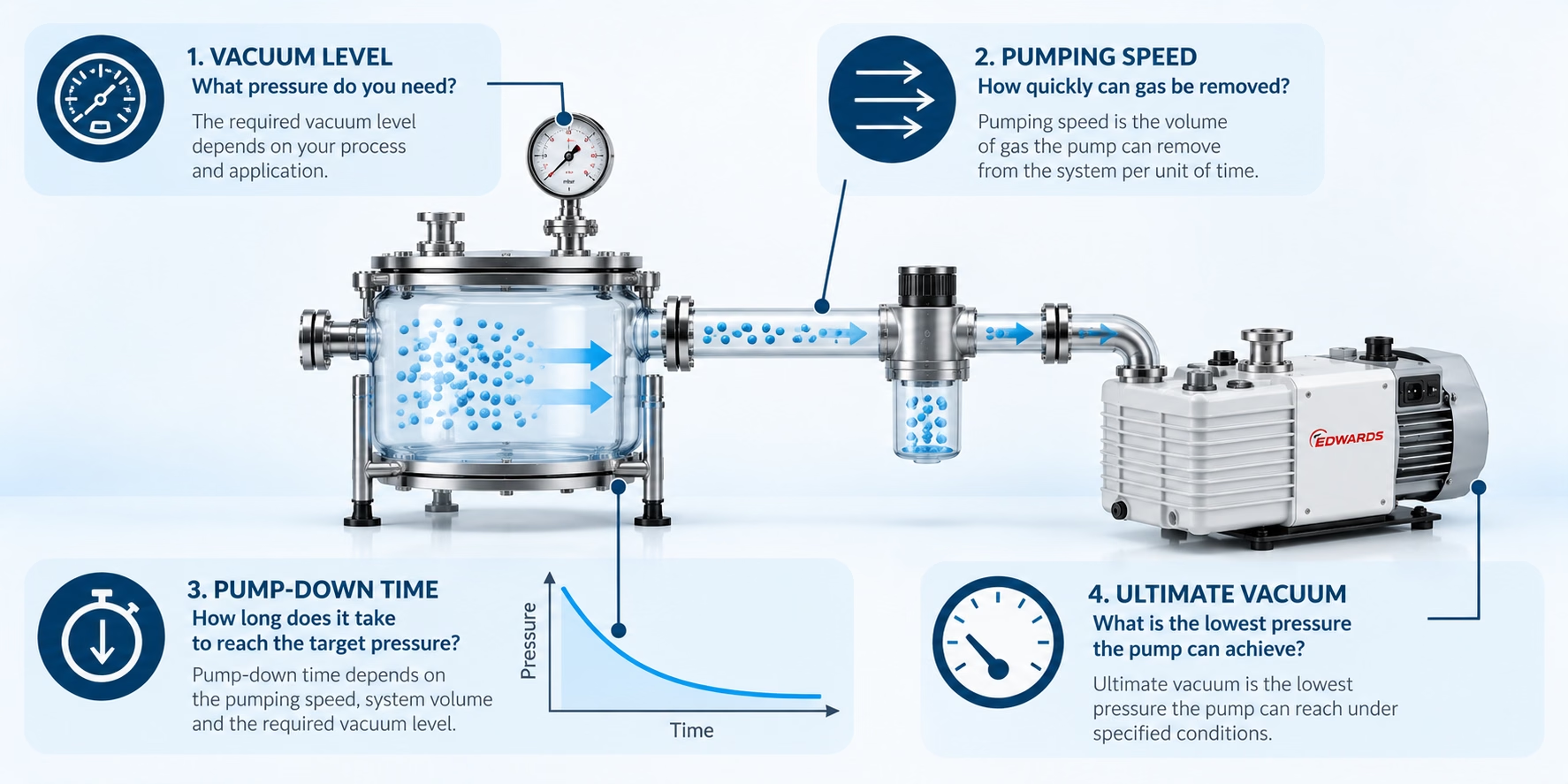
Don’t Forget the Vacuum System
One of the most important points when reviewing vacuum pump specifications is that the pump doesn’t operate in isolation.
The performance of the overall system can also be affected by:
- Pipework diameter and length
- Flanges and connections
- Valve sizing
- Leaks
- Filters and separators
- Process gas load
- Solvent or water vapour
- Condensation
- Particulate contamination
For example, a correctly specified pump connected through undersized or restrictive pipework may never deliver its expected performance at the process.
Likewise, excessive process gas load can prevent a system from reaching or maintaining its target pressure even where the pump itself is operating correctly.
Good vacuum system design therefore requires both the pump specification and the process conditions to be considered together.
Which Specification Is Most Important?
There isn’t one.
- The most important specification depends on what you’re trying to achieve.
- For a batch process where cycle time matters, pump-down time may be particularly important.
- For a process with continuous gas generation, pumping speed at the required operating pressure may be more significant.
- For an application requiring very low pressure, ultimate vacuum becomes more relevant.
This is why I would always start with the process requirements and then work backwards to the pump specification rather than selecting a pump based on the most impressive number on a datasheet.
Final Thoughts
Vacuum pump specifications are useful only when they’re considered in the context of the application.
Understanding vacuum level, pumping speed, pump-down time and ultimate vacuum gives you a much better basis for comparing pumps, but the complete vacuum system, process gases and operating conditions also need to be taken into account.
Getting those factors right at the selection stage helps achieve reliable vacuum performance without unnecessarily oversizing the equipment.
In the next article in this series, we’ll look at common vacuum pump problems and how to prevent them, including vacuum leaks, overheating, oil contamination and process liquids or solids entering the pump.
If you’re specifying a new vacuum system or reviewing the performance of an existing installation, Mason Technology can help assess your application and identify the most appropriate Edwards vacuum solution.
Need help interpreting vacuum pump specifications? Contact Mason Technology to discuss your application with one of our vacuum specialists.
Continue the Vacuum Pump Series
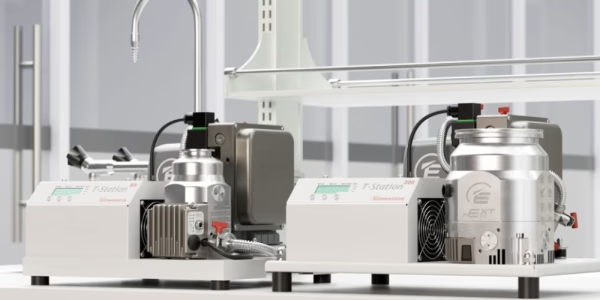
How to Choose the Right Vacuum Pump for Your Laboratory or Industrial Application
Learn how to choose the right vacuum pump for laboratory and industrial applications. Discover the key factors to consider before selecting a vacuum pump.
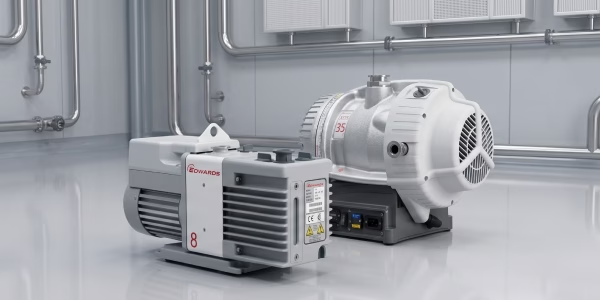
Oil-Sealed vs Dry Vacuum Pumps: Which Is Right for Your Application?
Compare oil-sealed and dry vacuum pumps, their advantages and key considerations, and learn which technology is best suited to your application.

RECENT POST
-
Vacuum Pump Specifications Explained: What Do the Key T...
Oct 01, 2026
Blog -
Mason Technology Appointed to Multiple Lots on NI Water...
Sep 21, 2026
News -
Oil-Sealed vs Dry Vacuum Pumps: Which Is Right for Your...
Sep 03, 2026
Blog -
Fast, Reliable Water Content Determination with EVA Kar...
Aug 31, 2026
Blog -
How to Choose the Right Vacuum Pump for Your Laboratory...
Aug 06, 2026
Blog -
Mason Technology Appointed Official Proteintech Distrib...
Aug 06, 2026
News -
Replacing Tap Water Cooling with Recirculating Chillers
Aug 05, 2026
Blog -
Mason Technology Appointed Irish Partner for Analytik J...
Jun 24, 2026
News