 info@masontec.ie


Polymer Testing: Key Methods for Consistent Plastics Quality
Maintaining consistent material quality is essential in plastics manufacturing. Whether producing injection-moulded components, packaging or extruded products, variations in polymer properties can affect processing efficiency, finished product performance and overall quality.
Factors such as moisture content, thermal behaviour, material composition and changes introduced during processing can all influence how a polymer performs. These challenges can become more complex when working with recycled materials or managing variations between suppliers and production batches.
Polymer testing helps manufacturers understand material properties, identify potential quality issues and make more informed decisions throughout production.
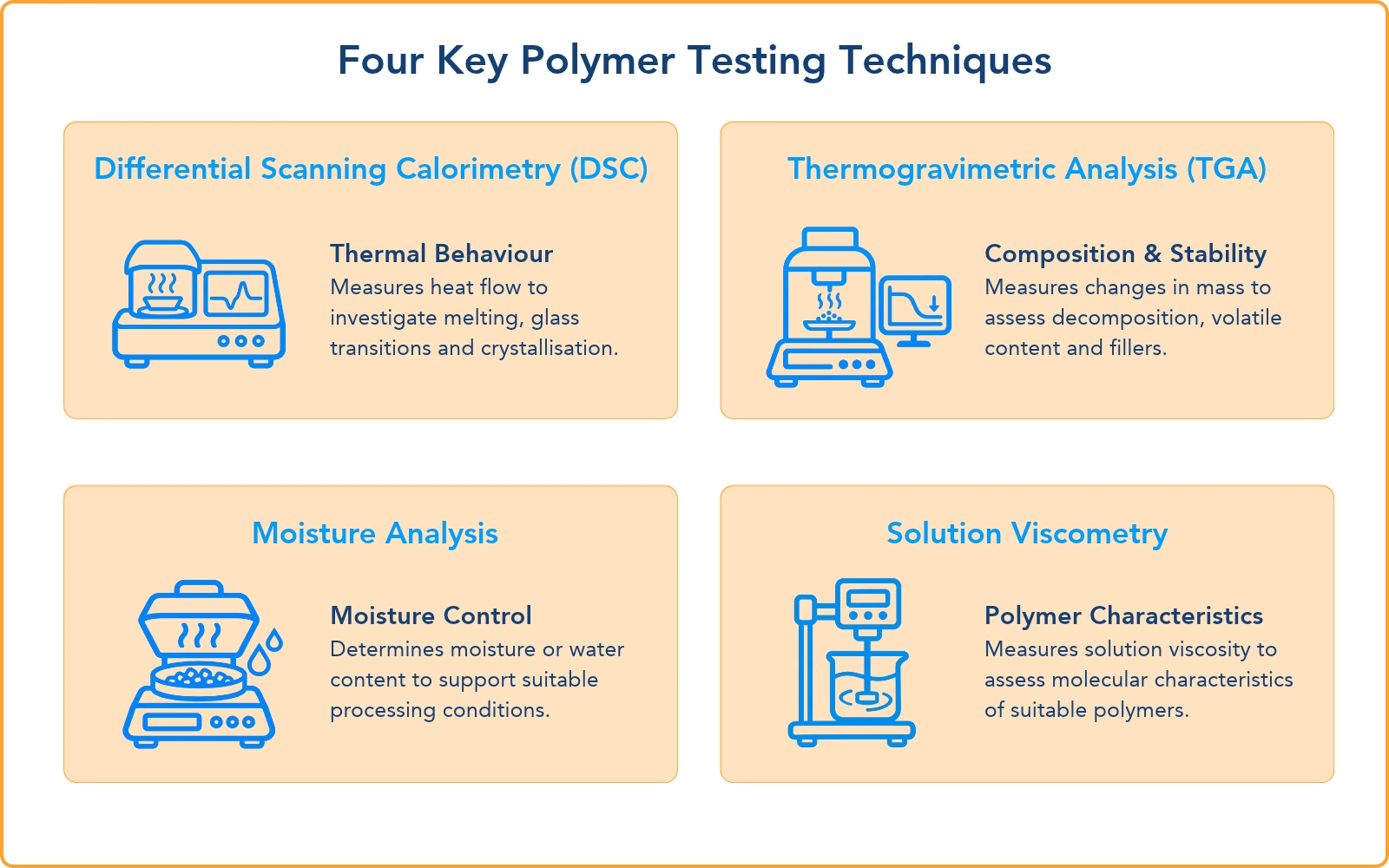
Four key analytical techniques can help manufacturers assess different aspects of polymer quality, as outlined below.
Understanding Thermal Behaviour with DSC
Temperature plays a critical role in plastics processing. Understanding how polymers respond to heating and cooling helps manufacturers optimise processing conditions and assess material consistency.
Differential Scanning Calorimetry (DSC) measures the heat flow associated with physical transitions and chemical reactions as a material is heated or cooled under controlled conditions.
For plastics manufacturers, DSC provides information about:
- Glass transition temperature: The temperature region where the amorphous portion of a polymer changes from a rigid, glassy state to a more mobile state.
- Melting behaviour: The temperatures at which crystalline regions of a polymer melt.
- Crystallisation: How a polymer forms crystalline structures during cooling or heating, influencing its properties and processing behaviour.
For example, DSC testing of polyethylene terephthalate (PET) can reveal differences in crystallisation and melting behaviour associated with a material’s thermal history.
These measurements are valuable when developing new materials, comparing raw material batches or investigating variations in finished products.
Mettler Toledo DSC systems support polymer characterisation, helping manufacturers better understand thermal properties and maintain consistent material quality.
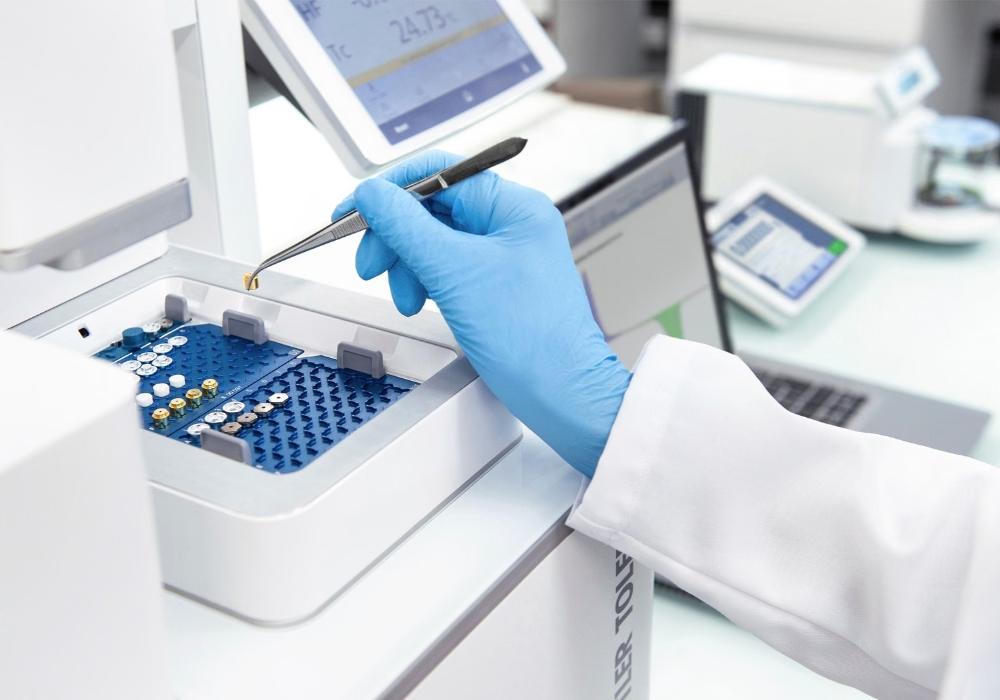
Assessing Polymer Composition and Stability with TGA
Plastics often contain additives, fillers and reinforcing materials that influence their properties and performance. Verifying material composition and understanding thermal stability are important considerations for quality control.
Thermogravimetric Analysis (TGA) measures changes in a sample’s mass as it is heated under controlled conditions.
This technique can provide information about:
- Thermal stability: Identifying the temperature ranges in which material decomposition occurs.
- Material composition: Assessing components such as fillers, carbon black and inorganic residues.
- Volatile content: Measuring mass losses associated with moisture, solvents or other volatile substances.
For example, TGA can help manufacturers evaluate filled polymers by measuring mass changes associated with polymer decomposition and the remaining filler content.
It is also relevant when assessing recycled polymers, where variations in material composition can affect processing and product consistency.
Mettler Toledo TGA systems support material development, formulation verification and quality investigations, providing complementary information to DSC testing.
Controlling Moisture Content in Plastic Pellets
Moisture can significantly affect plastics processing, particularly with hygroscopic materials such as polyamides, polycarbonate and certain polyesters.
These polymers can absorb moisture during storage, transportation and handling. If moisture levels exceed the recommended processing limits, problems such as surface defects, material degradation and reduced mechanical performance can occur.
Accurate moisture measurement helps manufacturers verify that materials are ready for processing and that drying procedures are effective.
Two commonly used techniques are:
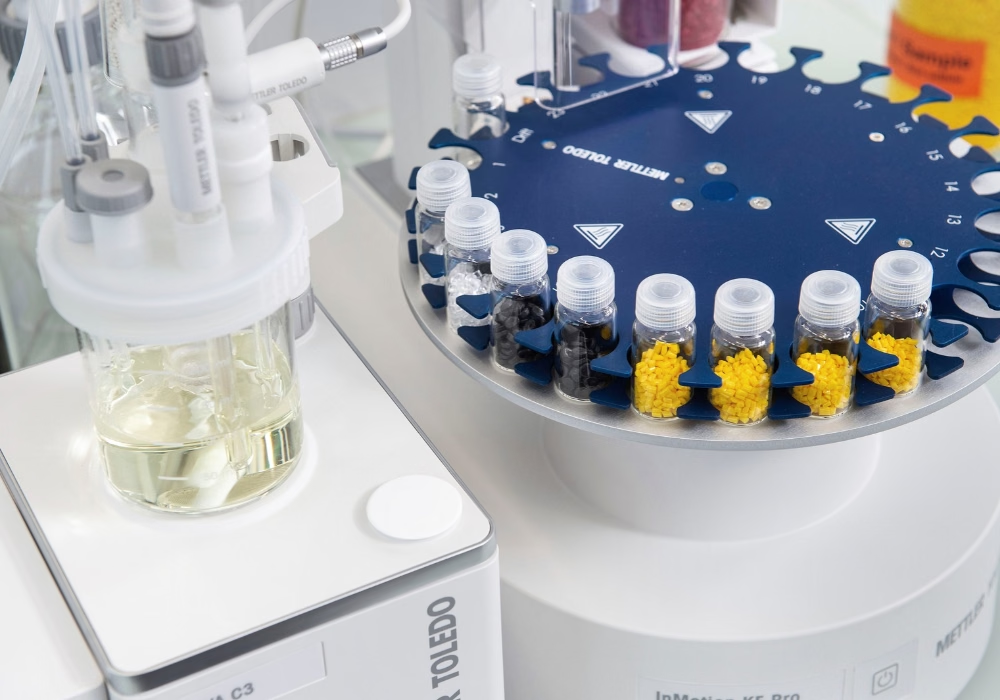
Halogen Moisture Analysis
Halogen moisture analysers determine the mass lost from a sample during controlled heating.
The Mettler Toledo HX204 offers a practical approach to routine moisture testing of suitable plastic pellets, allowing manufacturers to check material condition before processing.
Regular testing can help verify drying performance, reduce the risk of moisture-related defects and avoid unnecessary drying where materials already meet the required specification.
Karl Fischer Titration
Karl Fischer titration is a water-specific measurement technique, particularly valuable when accurate determination of low water content is required.
Unlike halogen moisture analysis, which measures total mass loss during heating, Karl Fischer titration specifically measures water.
The most appropriate method depends on the polymer, its composition and the required testing accuracy. For reliable results, measurement procedures should be validated against the relevant material specifications.
Both approaches can support better process control and help minimise avoidable production waste.
Evaluating Polymer Characteristics with Solution Viscometry
The molecular characteristics of a polymer influence its processing behaviour and final properties. Changes caused by manufacturing conditions, degradation or recycling can affect material consistency.
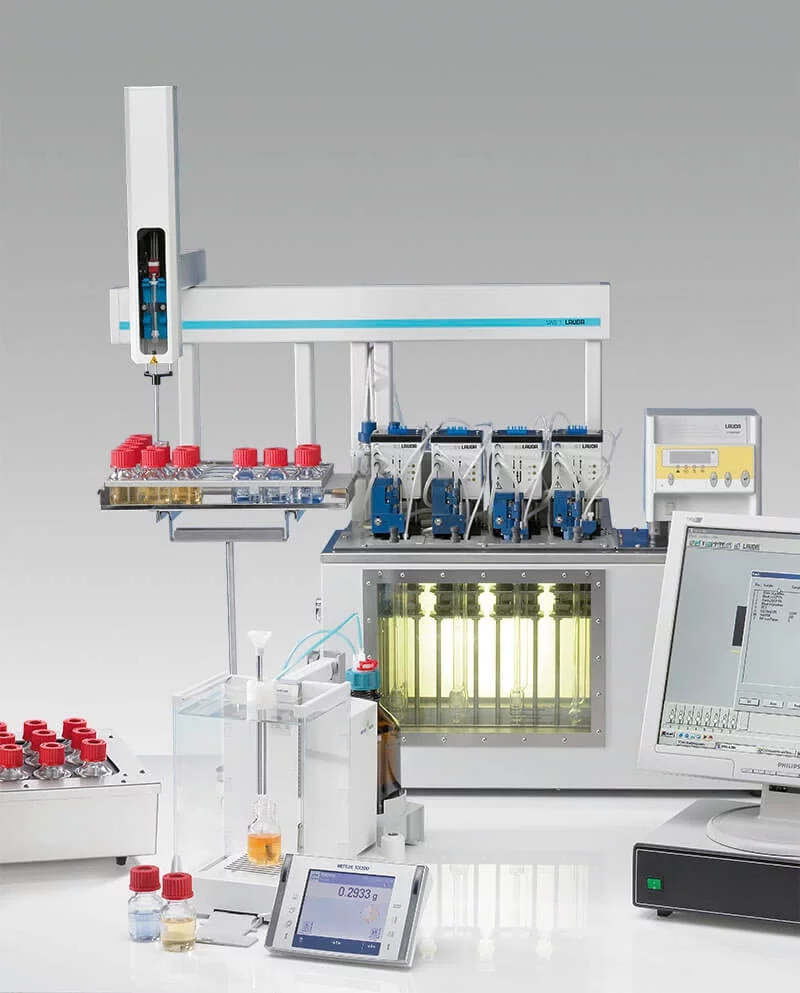
Solution viscometry provides a method for assessing the molecular characteristics of suitable polymers by measuring the viscosity of a polymer dissolved in a specified solvent.
The resulting measurements can provide information related to polymer molecular mass and chain length, helping manufacturers assess material quality and identify changes between batches.
Applications include:
- PET: Intrinsic viscosity testing to assess material characteristics, including changes associated with recycling or reprocessing.
- Polyamides and PBT: Viscosity number determination for material characterisation and quality control.
- PVC: K-value determination to assess polymer characteristics.
LAUDA Scientific offers a range of viscometry solutions, including the iVisc, S5 measuring systems and automated PVS systems, supporting routine testing and higher-throughput laboratory applications.
These technologies are particularly relevant to polymer producers, compounders, recycling facilities and materials testing laboratories.
Combining Testing Techniques for Better Quality Control
No single testing method provides a complete picture of polymer quality. Different techniques help manufacturers understand different characteristics of their materials.
For example, moisture analysis can establish whether raw materials meet processing requirements, while DSC and TGA provide information about thermal behaviour, composition and stability. Solution viscometry can offer further insight into molecular characteristics where applicable.
By combining appropriate testing methods, manufacturers can improve their understanding of material properties, investigate variations and make more informed decisions about processing and quality control.
Polymer Testing Solutions from Mason Technology
Mason Technology supports plastics manufacturers, research laboratories and quality control teams with analytical instrumentation from leading manufacturers, including Mettler Toledo and LAUDA Scientific.
Our portfolio includes thermal analysis systems, moisture analysers, Karl Fischer titrators and polymer viscometry solutions, supported by specialist technical advice, calibration and maintenance services.
Whether verifying raw material quality, developing polymer formulations or investigating manufacturing inconsistencies, our team can help identify the appropriate testing technology for your application.
Explore our Thermal Analysis, Moisture Analysis and Viscometry solutions, or contact Mason Technology to discuss your polymer testing requirements.

RECENT POST
-
Mechanical Testing of Plastics: Evaluating Strength, Fl...
Nov 20, 2026
Blog -
Webinar: Purifying Peptides and Proteins with Flash and...
Nov 20, 2026
Webinars -
Smarter Laboratory Workflows: Taking a Practical Approa...
Nov 19, 2026
News -
Polymer Testing: Key Methods for Consistent Plastics Qu...
Nov 19, 2026
Blog -
How to Improve Colour Consistency in Plastics Manufactu...
Nov 09, 2026
Blog -
From Measurement to Data Integrity: Supporting Confiden...
Nov 09, 2026
News -
Mason Technology Sponsors Sustainability Initiative of ...
Nov 06, 2026
News -
Mason Technology Appointed BMG LABTECH Agent in Ireland
Nov 03, 2026
News