 info@masontec.ie


How to Improve Colour Consistency in Plastics Manufacturing
Colour consistency is an important quality consideration in plastics manufacturing. Whether producing injection-moulded components, packaging, extruded materials or consumer products, manufacturers must ensure that finished parts meet specified colour and appearance requirements.
However, maintaining consistent colour throughout production can be challenging. Variations in raw materials, pigments, processing conditions and recycled content can all influence the appearance of finished products.
Even small differences can lead to rejected batches, additional production costs and customer complaints, particularly where components from different suppliers must match.
Objective colour measurement helps manufacturers identify variation, maintain agreed quality standards and make more informed decisions throughout the production process.
Why Is Colour Consistency Challenging in Plastics Manufacturing?
The colour of a finished plastic component is influenced by several factors, from the initial material formulation through to the manufacturing process.
Common causes of colour variation include:
- Raw material differences: Changes in resin, masterbatch or pigment properties can affect the final shade.
- Formulation and dosing: Inconsistent pigment concentrations or mixing can lead to differences between production batches.
- Processing conditions: Temperature, residence time and other processing parameters can influence colour, particularly where materials are susceptible to degradation.
- Recycled materials: Differences in the colour and composition of recycled polymers can introduce additional variability.
- Surface finish: Texture and gloss can change how a colour is perceived, even when the underlying material colour is similar.
For manufacturers, the challenge is not simply identifying whether a part looks correct. It is determining whether its colour meets an agreed specification and understanding when and where variation occurs.
Moving Beyond Visual Colour Assessment
Visual inspection remains an important part of quality control, but it has limitations.
Colour perception can vary between individuals and under different lighting conditions. Two components that appear identical in one environment may look different under another light source.
This becomes particularly problematic where manufacturers need to reproduce a customer’s specified colour or maintain consistency across different production facilities and suppliers.
Spectrophotometers provide an objective alternative by measuring the light reflected or transmitted by a sample. The resulting data can be expressed using established colour systems such as CIELAB, allowing manufacturers to quantify differences between a production sample and an approved standard.
Rather than relying solely on visual judgement, quality teams can define acceptable colour tolerances and use consistent measurement methods to assess whether products meet requirements.
This supports more reliable quality decisions and clearer communication between manufacturers, suppliers and customers.
Where Can Colour Measurement Improve Plastics Production?
Colour measurement can be incorporated at several stages of manufacturing, helping teams identify issues before they affect larger quantities of material or finished products.
Raw Materials and Masterbatch Quality Control
For manufacturers using pigments, masterbatches or compounded materials, colour consistency begins before production.
Checking incoming materials against defined standards helps identify differences between suppliers or batches. It can also support formulation development, where pigment concentrations must be adjusted to achieve a required colour.
Objective measurement provides a more consistent basis for evaluating materials before they are introduced into production.
In-Process and Finished Product Inspection
Injection moulding, extrusion and other plastics-processing methods can introduce colour variation during manufacturing.
By measuring production samples against approved standards, manufacturers can detect shifts in colour and investigate potential causes, such as material changes, dosing variation or processing conditions.
Identifying deviations earlier allows production teams to take corrective action before substantial quantities of material are affected.
Finished product measurement also provides documented evidence that components meet customer or internal specifications.
Managing Colour Variation in Recycled Plastics
As manufacturers incorporate more recycled polymers into their products, maintaining a consistent appearance can become more complex.
Recycled materials may contain variations in base colour, pigmentation or composition depending on their source and previous processing history.
Colour measurement enables manufacturers to assess incoming recycled materials, monitor differences between batches and make informed adjustments to formulations.
This can help manufacturers increase the use of recycled content while maintaining defined appearance requirements.
Measuring Transparent and Translucent Plastics
Not all plastic materials can be assessed using the same measurement approach.
Opaque materials are typically evaluated using reflected light, while transparent and translucent products may require transmission measurements.
This is particularly relevant for applications such as plastic films, packaging and PET preforms, where transmitted colour and material transparency contribute to product appearance.
Selecting an appropriate measurement method is essential to obtaining meaningful and repeatable results.
Why Colour Alone May Not Tell the Full Story
The appearance of a plastic component is not determined by colour alone.
Surface texture, gloss and manufacturing finish can influence how a product looks. For example, two components may have similar measured colour values but appear different because one has a high-gloss finish and the other has a matt or textured surface.
For applications where visual appearance is particularly important, measuring colour alongside gloss can provide a more complete assessment.
This is relevant to automotive components, consumer products, packaging and other applications where multiple parts must achieve a consistent appearance.
Selecting the Right Colour Measurement Technology
Different plastics applications require different approaches to measurement. Factors such as sample size, surface finish, opacity and the location of testing should all be considered when selecting an instrument.
Konica Minolta offers a range of colour measurement technologies available through Mason Technology, including:
Portable Spectrophotometers
Instruments such as the Konica Minolta CM-26d and CM-26dG support colour measurement directly on plastic components, including larger parts that may be difficult to bring into a laboratory.
The CM-26dG also incorporates gloss measurement, allowing colour and gloss to be evaluated within the same inspection process.

Benchtop Spectrophotometers
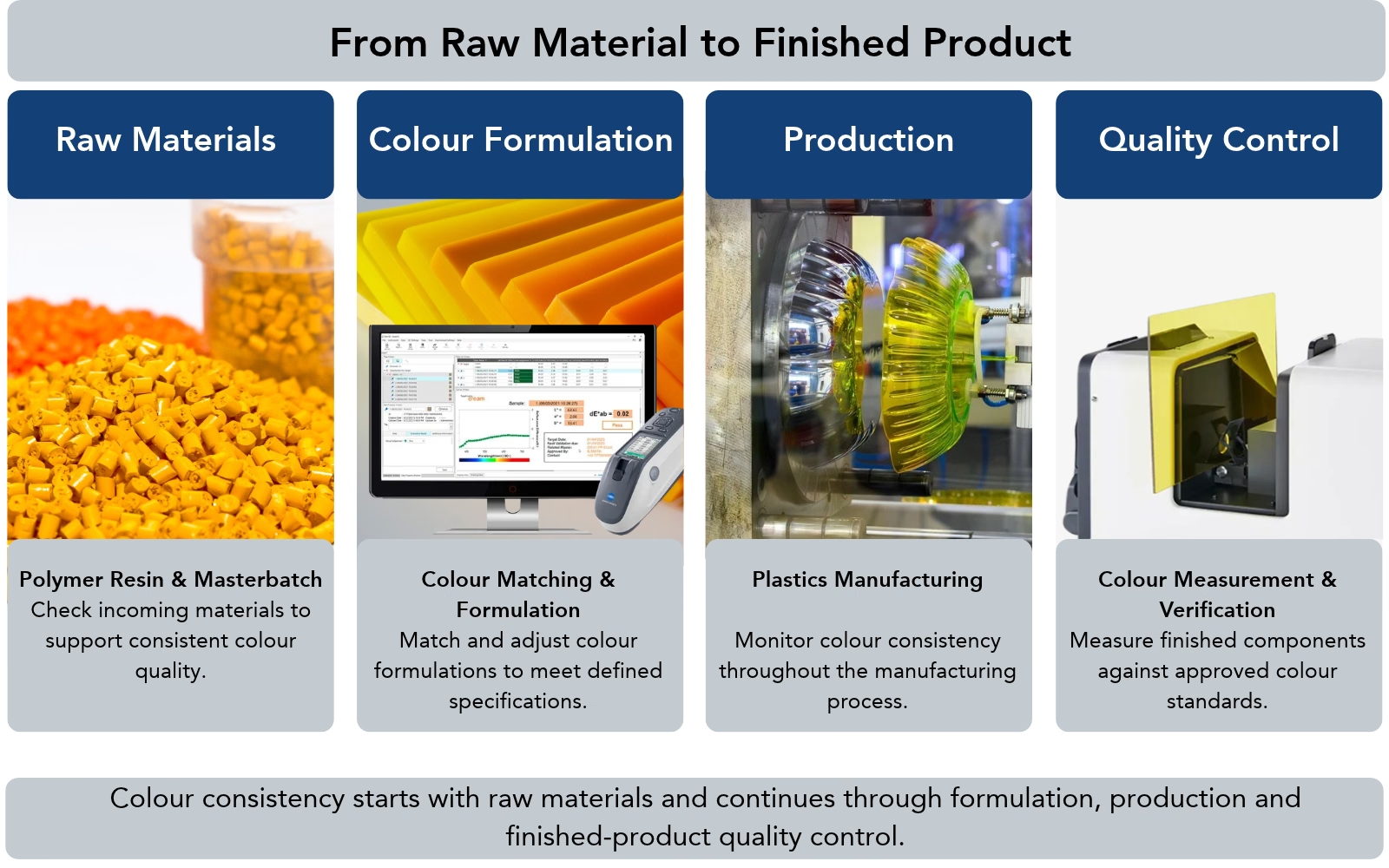
The Konica Minolta CM-5 is suitable for laboratory and quality control applications involving different sample types, including solid, granular, liquid and transparent materials.
Its reflectance and transmission measurement capabilities make it particularly versatile for evaluating plastics at different stages of production.
Colour Quality Control Software
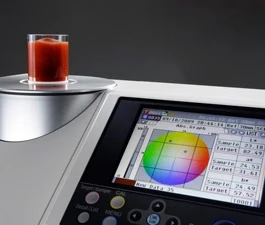
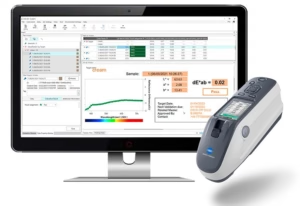
Measurement instruments can also be supported by software that helps manufacturers manage colour standards, tolerances and measurement results.
By maintaining consistent digital records, quality teams can monitor variation, compare production batches and communicate specifications more effectively across facilities and supply chains.
Improving Quality and Reducing Manufacturing Waste
Effective colour management is about more than achieving the correct appearance. It is also about maintaining control over manufacturing processes.
By introducing consistent measurement practices, plastics manufacturers can:
- Identify colour variation earlier in production.
- Reduce the risk of rejected batches and unnecessary rework.
- Improve consistency between suppliers, production sites and finished products.
- Support quality control when incorporating recycled materials.
- Maintain clearer records of compliance with customer colour specifications.
The greatest benefits come from integrating colour measurement into an established quality process, with agreed standards, suitable measurement conditions and clear procedures for responding to deviations.
Colour Measurement Solutions from Mason Technology
Mason Technology supplies Konica Minolta colour measurement solutions to manufacturers and laboratories across Ireland.
Our range includes portable and benchtop spectrophotometers, supported by specialist technical advice, calibration and maintenance services.
Whether you are assessing incoming polymer materials, monitoring colour during manufacturing or verifying the appearance of finished plastic components, our team can help identify the appropriate measurement technology for your application.
Explore our Colour Measurement Solutions or contact Mason Technology to discuss your requirements.

RECENT POST
-
How to Improve Colour Consistency in Plastics Manufactu...
Nov 09, 2026
Blog -
From Measurement to Data Integrity: Supporting Confiden...
Nov 09, 2026
News -
Mason Technology Sponsors Sustainability Initiative of ...
Nov 06, 2026
News -
Mason Technology Appointed BMG LABTECH Agent in Ireland
Nov 03, 2026
News -
Sustainability in Pharma: Practical Improvements Across...
Nov 03, 2026
News -
Six Common Vacuum Pump Problems and How to Prevent Them
Nov 02, 2026
Blog -
Vacuum Pump Specifications Explained: What Do the Key T...
Oct 01, 2026
Blog -
Mason Technology Appointed to Multiple Lots on NI Water...
Sep 21, 2026
News