 info@masontec.ie

CAMAG HPTLC Workflow for Irish TLC Laboratories
A Practical, Step-by-Step Workflow with CAMAG
If TLC forms part of your routine analysis, the challenge is familiar. The technique is well established, but outcomes can vary depending on the analyst, the application technique and the development conditions on the day. For laboratories operating under increasing quality and compliance expectations across Ireland’s pharmaceutical, biopharma, food and environmental sectors, that variability can quickly become a limitation.
CAMAG has developed a modular HPTLC workflow that allows laboratories to standardise the most critical stages of TLC analysis, from sample application through to detection and documentation, without forcing a move to full automation from day one.
Who This Workflow Is Designed For
This approach is particularly relevant if your laboratory needs to improve repeatability across analysts and shifts, increase throughput while maintaining traceability, support both qualitative and quantitative evaluation, or produce consistent documentation suitable for audits, method transfer and long-term data storage.
Crucially, the workflow is modular. Many laboratories start by addressing a single pressure point such as inconsistent sample application and expand only when the method or workload demands it.
The CAMAG HPTLC Workflow
1. Plate Cutting and Preparation
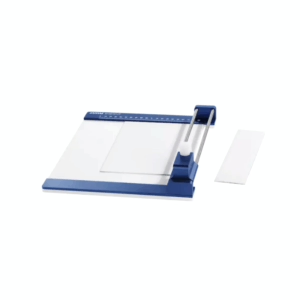
CAMAG smartCut
A consistent HPTLC workflow begins before any samples are applied. Plate preparation plays a critical role in achieving reproducible results, particularly when multiple analysts or methods are involved. Variations in plate size or poorly cut edges can introduce subtle but avoidable inconsistencies later in the process.
The CAMAG smartCut system is designed to cut pre-coated TLC and HPTLC glass plates accurately and cleanly into defined formats. This supports better plate handling, reduces waste, and ensures downstream steps such as application and development are carried out on plates with uniform dimensions. For laboratories preparing multiple plates per run, this step helps establish a controlled starting point for the entire analysis.
2. Automated Sample Application
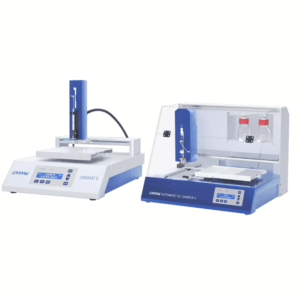
Linomat 5 or Automatic TLC Sampler 4 (ATS 4)
Sample application is one of the most influential steps in TLC and HPTLC analysis. Manual spotting can introduce variability in spot size, position and solvent delivery, which directly affects separation quality and repeatability, particularly when results are compared across analysts or time.
CAMAG’s automated application systems are designed to remove this source of variability. Linomat 5 supports precise, semi-automatic application for controlled method development, while the Automatic TLC Sampler 4 enables fully automated, high-precision application for higher throughput environments. Both systems ensure consistent sample delivery, creating a reliable foundation for reproducible chromatographic results.
3. Controlled Plate Development
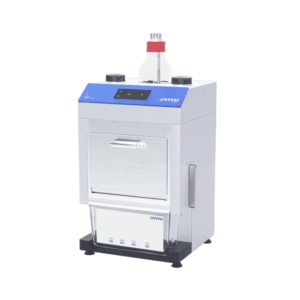
Automatic Developing Chamber 3 (ADC 3)
The plate development stage has a major impact on separation performance and overall method reliability. In manual development, factors such as chamber saturation, solvent migration and ambient humidity can vary between runs, leading to inconsistent separations.
The Automatic Developing Chamber 3 is designed to standardise these critical parameters. It automates development steps including saturation and drying, while allowing humidity to be controlled as part of the method. Designed for 20 × 10 cm HPTLC plates, the ADC 3 helps laboratories achieve consistent, repeatable development conditions across single or multiple plates.
4. Consistent Derivatisation
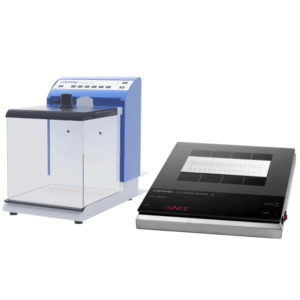
CAMAG Derivatizer and TLC Plate Heater 3
Derivatisation is often required to enhance compound visibility or selectivity, but it is also one of the most variable steps when carried out manually. Uneven reagent application or inconsistent heating can make direct comparison between plates difficult.
CAMAG’s derivatisation solutions are designed to improve reproducibility at this stage. The Derivatizer ensures uniform application of reagents across the plate, while the TLC Plate Heater 3 provides controlled heating from 25 to 200 °C where required. Together, they help ensure derivatisation reactions are applied consistently and predictably.
5. Quantitative Detection
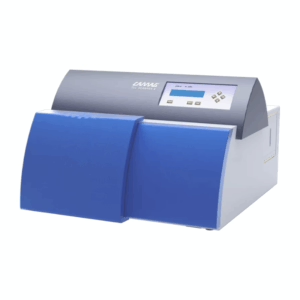
TLC Scanner 4
Visual inspection alone is often sufficient for basic screening, but it can limit confidence when results need to be compared or quantified. For laboratories moving towards more robust analytical outcomes, objective detection becomes increasingly important.
The TLC Scanner 4 enables densitometric evaluation of TLC and HPTLC chromatograms across a spectral range of 190 to 900 nm. When combined with controlled application and development, it supports reliable quantitative and semi-quantitative analysis, helping HPTLC function as a defensible analytical technique rather than a purely visual tool.
6. Visualisation and Documentation
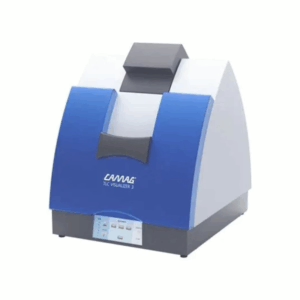
TLC Visualizer 3
Visual evaluation remains a core part of TLC and HPTLC workflows, particularly for identity testing and comparative analysis. However, traditional UV cabinets can produce uneven illumination and inconsistent documentation.
The TLC Visualizer 3 provides uniform imaging under white light, short-wave UV at 254 nm and long-wave UV at 366 nm. High-quality digital images are captured consistently and stored electronically, supporting traceability, reporting and long-term record keeping. This makes visual evaluation more reliable and easier to standardise across users.
7. Optional Hyphenation with Mass Spectrometry
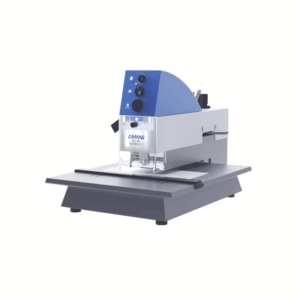
TLC-MS Interface 2
In some applications, additional analytical confirmation is required beyond chromatographic separation alone. This is particularly true when investigating unknowns, impurities or complex sample matrices.
The TLC-MS Interface 2 allows selected zones to be eluted directly from the plate into a mass spectrometer. This approach reduces sample preparation steps and enables rapid compound identification, providing an efficient route to confirmatory analysis when required.
8. Centralised Control and Data Evaluation
visionCATS Software
As HPTLC workflows become more automated, effective data management and instrument control become increasingly important. Disconnected systems can introduce inefficiencies and increase the risk of inconsistent documentation.
visionCATS software provides centralised control of CAMAG instruments along with tools for method management, image storage and result evaluation. By bringing data and workflows together in a single platform, it supports consistency, traceability and confidence across the entire HPTLC process.

Practical Considerations Before You Commit
From a Mason Technology perspective, there are several practical points worth considering early to ensure a successful implementation.
Laboratory space and layout should support a logical workflow, particularly if future expansion is planned. Plate format requirements are important, as systems such as the ADC 3 are specified for 20 × 10 cm HPTLC plates, which can influence method transfer. Derivatisation strategy should be driven by chemistry and method requirements rather than equipment preference. Laboratories operating under regulatory frameworks should also consider software, documentation and validation expectations at the outset rather than retrofitting them later.
Key Takeaways
Manual TLC introduces avoidable variability that becomes increasingly problematic as quality expectations rise. CAMAG’s HPTLC systems provide a modular route to standardisation, allowing laboratories to automate what matters most without overcommitting. The greatest gains typically come from controlled sample application, development and derivatisation, supported by appropriate detection and software-driven documentation. Mason Technology helps ensure these systems are implemented in a way that fits the reality of Irish laboratories, not just the specification sheet.
How Mason Technology Supports Irish Laboratories
Our role goes beyond supplying instrumentation. We work with laboratories to assess existing TLC workflows, identify where automation delivers the most value and build systems that are appropriate to current and future needs.
In many cases, this means starting with a single upgrade such as automated application or improved documentation, then scaling into controlled development or quantitative detection as requirements evolve. Installation, training and long-term service support are part of that conversation from day one.
Should you wish to discuss the HPTLC technique and available CAMAG Thin Layer Chromatography portfolio, please do not hesitate to contact me directly.

RECENT POST
-
Vacuum Pump Specifications Explained: What Do the Key T...
Oct 01, 2026
Blog -
Mason Technology Appointed to Multiple Lots on NI Water...
Sep 21, 2026
News -
Oil-Sealed vs Dry Vacuum Pumps: Which Is Right for Your...
Sep 03, 2026
Blog -
Fast, Reliable Water Content Determination with EVA Kar...
Aug 31, 2026
Blog -
How to Choose the Right Vacuum Pump for Your Laboratory...
Aug 06, 2026
Blog -
Mason Technology Appointed Official Proteintech Distrib...
Aug 06, 2026
News -
Replacing Tap Water Cooling with Recirculating Chillers
Aug 05, 2026
Blog -
Mason Technology Appointed Irish Partner for Analytik J...
Jun 24, 2026
News